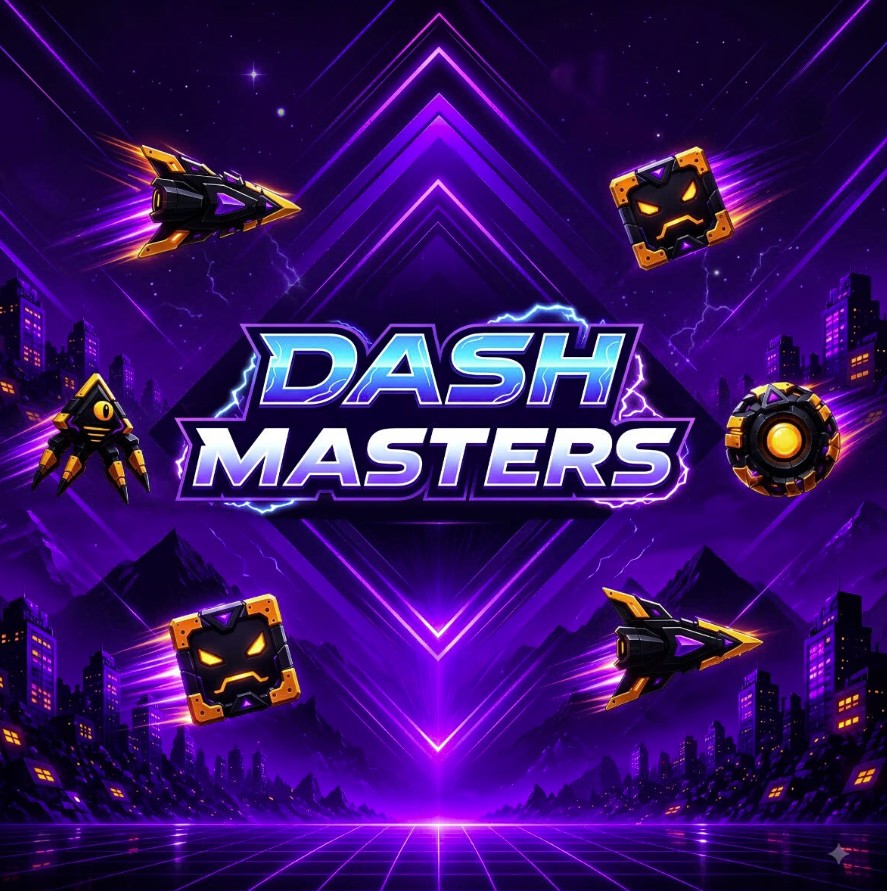
Dash Masters
Dash Masters Mods Game
Zombie Dash
Rainbow Tsunami
Shapik The Quest

Do Dragons Exist
Goat Rampage
Tower Rise
Horror Nun 2
Sprunki Square Shifted
Obby Survive Parkour

Bees Empire Clicker

Paint Or Hunt
Super Bear Adventure
Brave Squad
Sprunki Hyper Shifted Phase 3 Remastered
Left Or Right Spranki Beats
1 Speed Keyboard Lucky Escape
Traffic Racing
Rider Rush
Sprunki Phase 9 Ggtp
Rooster Road



How To Play Dash Masters
At its core, Dash Masters is a single-input action experience. On PC, players can trigger a jump using the mouse, the Spacebar, or the Up Arrow key, while on mobile, a quick tap on the screen performs the same action. The character moves forward automatically, leaving you with only one responsibility: executing precise leaps at the right moments. Each level is filled with threats like spiked barriers, rotating blades, and shifting platforms. Any contact with these dangers immediately ends your attempt and returns you to the starting point. Precision is therefore the defining skill, and there is little room for hesitation.
The obstacles are arranged in carefully measured, cadence-based patterns, and the soundtrack often serves as a reliable guide. Paying close attention to the beat is essential, as many jumps are deliberately placed on strong musical accents. To help you master difficult passages, Practice Mode allows you to set waypoints near challenging sections, letting you focus on a specific area rather than repeating the entire course. In addition, later stages introduce special portals that alter gravity, speed, or the movement style of your icon, adding fresh layers of difficulty and strategy.
A few precautions can greatly improve your progress. Avoid pushing forward too quickly; instead, learn the rhythm of each phase and let the music inform your decisions. If a section keeps defeating you, use Practice Mode repeatedly until the timing becomes second nature. Remember that every failed run is still a learning opportunity—each restart brings you closer to understanding the level's structure. With patience, careful listening, and a willingness to retry, Dash Masters becomes not just a test of reflexes, but a deeply satisfying rhythm-based challenge that rewards persistence and focus above all else.
Dash Masters Wiki
Dash Masters: A Precision-Driven Rhythm Platformer
Dash Masters has emerged as a highly energetic rhythm-based platformer that appeals to gamers who relish challenging, accuracy-heavy experiences. It clearly borrows from the design language of Geometry Dash, yet it pares down unnecessary systems and concentrates on one of gaming’s most basic tests: push forward without pause while overcoming whatever lies ahead. The result is a title that pairs apparent minimalism with genuine depth, demanding not complex inputs or elaborate combos, but rather perfect timing, focused attention, and pattern familiarity. Regardless of whether you are an experienced rhythm-game veteran or a newcomer seeking a tough arcade-style challenge, Dash Masters provides a refined and satisfying ride. The sections below take a closer look at its central concept, gameplay mechanics, standout elements, and practical advice for raising your skill level.
Summary
Dash Masters is a briskly paced, music-synced platformer that revolves around an icon in perpetual motion, forcing players to navigate dense, hazard-packed stages. It fuses the exactness of geometric leaping with the timing clues supplied by the soundtrack, creating an experience where memory, rhythm, and split-second reflexes all matter. Throughout each level, you will encounter a steady stream of spikes, rotating blades, shifting obstacles, and gravity-defying portals, with the music energizing the pace. The central objective is simple: maneuver the icon from the opening point of a level to its endpoint without making a fatal mistake. Any collision triggers an immediate reset, encouraging players to analyze what went wrong and gradually chart the safest possible route. Drawing strong inspiration from the core mechanics of Geometry Dash, Dash Masters condenses the rhythm-platformer formula into a clean, accessible package. It rewards consistent rhythm and sharp observation rather than careless or arbitrary tapping. Every crash offers a lesson, and every completed run is a genuine sign of mastery.
How to Play
Learning to play Dash Masters takes seconds; mastering it is a completely different matter. The input system is deliberately sparse. On a PC, jumping is handled with the mouse, the Spacebar, or the Up Arrow key. On a mobile device, a simple tap on the screen performs the same action. Because the avatar automatically moves forward, there is no need to manage acceleration or braking. Every attempt is stripped down to a single critical decision: when should you jump?
That minimalist approach is deceptive. Every spike, saw, and platform edge demands exacting timing. A jump that comes a single frame too early or too late will almost certainly end the run. To keep players alert, the game steadily introduces new mechanics as the stages progress. Portals play the most significant role in this process. A gravity-reversal portal can turn the entire stage upside down, forcing you to immediately adjust to landing on ceilings. A speed portal can accelerate or slow down your movement, changing the distance of your next jump in the middle of the level. Other portals convert the icon into alternate forms, such as a cube or a ship-like state, each possessing unique physics. These transformations require rapid adaptation and a deeper understanding of how movement works in the game.
Practice Mode is one of the most valuable tools available. It allows you to place checkpoints anywhere within a level, making it possible to drill a difficult section without replaying the whole stage from scratch. This feature is not a crutch; it is a strategic necessity. The levels are long and highly precise, and attempting to learn a late-game segment through repeated full runs is an inefficient use of time. By isolating the troublesome parts, you can devote your full attention to exact jump timings and portal transitions. Once those moments are firmly committed to memory, you can connect them into one clean, continuous run.
Rhythm is the most important skill to develop. Because Dash Masters aligns its obstacles with musical beats, players who depend purely on visual reaction will quickly become overwhelmed. Instead, mentally counting along with the music helps you internalize jump timings. The opening stages ease you into this mindset with wider gaps and slower tempos. Later levels demand faster, more precise responses, and the song becomes an essential guide rather than mere background noise.
Key Features
Dash Masters may look minimal on the surface, but its feature set is intentionally crafted to create depth and variety within a simple framework. The following are the defining aspects of the experience.
-
Highly responsive, minimalist controls: The control scheme is deliberately barebones. A single jump command on PC or mobile removes mechanical clutter and places all difficulty squarely on timing. The resulting accuracy feels excellent for players who appreciate skill-based, arcade-style play.
-
Uninterrupted forward momentum: The icon never stops moving, and you cannot alter its speed or direction. Instead, every jump must be planned based on what appears ahead. This limitation is the core of the challenge, pushing players to think in advance and mentally prepare for the next hazard.
-
Portal-based transformation mechanics: Certain areas contain portals that drastically change the icon’s behavior. A gravity-reversal portal flips the world, demanding that you land on ceilings. Speed portals accelerate or slow the action, shifting the timing of every subsequent jump. These mechanisms prevent monotony and add an extra layer of strategic thinking, especially when multiple portals appear in quick succession.
-
Music-driven level design: Obstacles are never placed at random. The stage layouts are synchronized with the soundtrack, so many jumps feel like notes in a larger composition. This design choice goes beyond simple aesthetics—it provides a reliable timing reference. Players who can feel the beat will find the game much more intuitive and less chaotic.
-
Practice Mode: This feature is invaluable for anyone serious about conquering difficult levels. It allows you to set checkpoints and repeatedly attempt a short segment without restarting from the beginning. Rather than being an optional extra, it functions as a genuine training tool for building pattern recognition and muscle memory.
-
Gradual difficulty scaling: Dash Masters starts out forgiving enough to teach the fundamentals, then gradually introduces faster tempos, denser hazards, and more complex portal combinations. The curve is designed to create a noticeable sense of improvement, while still offering a serious challenge to experienced players.
Precautions/Tips
Success in Dash Masters depends on mental preparation, pattern familiarity, and disciplined reflexes. The first and most important piece of advice is to treat failure as a learning mechanism rather than a setback. Every crash provides useful information: it tells you whether a jump was too early, too late, or mistimed relative to the music. The sooner you accept death as a natural part of the learning process, the faster your progress will be.
One of the most effective strategies is to listen to the music actively. Instead of focusing only on the visual hazards, try to recognize the underlying beat structure. Many obstacles are placed in alignment with downbeats and rhythmic accents. If you keep missing the same jump, pause for a moment, close your eyes, and feel the pulse of the track. You may find that your body instinctively knows when to jump, even before your conscious mind registers the obstacle. This kind of audio-motor coordination is central to the Dash Masters experience.
When dealing with portals, it is wise to break the transition down mentally. After a gravity reversal or a speed shift, the physical layout of the level remains the same, but your relationship to it changes dramatically. Practice these moments in Practice Mode until your hands adapt naturally. It also helps to keep some awareness of what comes immediately after a portal, because the first jump following a mechanical change is often the most dangerous.
Precautions/Tips
Dash Masters can be a mentally demanding game. Because the margin for error is so tiny and precise timing is essential, frustration can build quickly. The most important tip is to remain calm and treat every attempt as an experiment. Instead of expecting immediate completion, focus on advancing one obstacle at a time. Memorizing a level’s pattern is not a shortcut; it is an essential part of the intended experience.
When you approach a new section, try to identify a reference point—a specific musical beat, a visual mark on the ground, or a platform edge—that triggers your jump. Anchoring your timing to consistent signals reduces the chance of jumping too early or too late under pressure. The same idea applies when a speed portal alters the pace; both the visual cue and the rhythm change, so do not rely purely on what worked in the previous segment.
For players who feel stuck, stepping away for a short break is often the best move. Fatigue degrades both reflexes and concentration, and continuing to play while frustrated usually leads to sloppy inputs. Returning with a refreshed mind can make a difficult section feel far more manageable. Also, be mindful of your screen and input device. A clean, responsive mouse or a stable touchscreen makes a noticeable difference in a game that measures timing in fractions of a second.
Finally, do not ignore the audio. Playing with the sound off removes one of the most important feedback systems the game offers. The music is not decorative; it is a map to the level’s layout. For maximum control, keep the volume at a comfortable level and let the beat sink into your muscle memory. Over time, your jumps will feel less like calculated decisions and more like natural responses—exactly the state of mind Dash Masters is designed to cultivate. With persistence, discipline, and a good ear, even the most punishing courses can be conquered.
Dash Masters Frequently Asked Questions
Q: What is Dash Masters?
A: Dash Masters is an energetic rhythm-based platformer drawing inspiration from the fundamental mechanics of Geometry Dash. In this game, you guide an icon that never stops moving, and you need to respond swiftly to various obstacles.
Q: What is the main goal in Dash Masters?
A: The primary objective is to journey from the very beginning of a stage all the way to its end without suffering a single crash or collision.
Q: What are the basic controls on PC?
A: If you are playing on a computer, you can make your character jump by using the mouse, pressing the Spacebar, or hitting the Up Arrow key.
Q: What are the controls on mobile?
A: On mobile devices, simply tapping the screen will make your character jump or activate an interaction.
Q: Does the player character move automatically?
A: Yes, your icon advances forward continuously without any manual input, so your main task is to time your actions correctly.
Q: What types of obstacles can appear in Dash Masters?
A: You will encounter a wide range of hazards, including spikes, rotating saws, moving platforms, portals, and various other dangerous elements.
Q: How do portals affect gameplay?
A: Portals have the ability to alter gravity, change your speed, or transform your current movement mode, which can drastically shift the gameplay experience.
Q: How does music help in Dash Masters?
A: The soundtrack serves as an essential rhythmic guide, giving you valuable audio cues that allow you to predict and prepare for many incoming obstacles.
Q: What is Practice Mode used for?
A: Practice Mode is designed to help you slow things down and gradually master difficult sections one obstacle at a time, which proves especially useful when a particular part seems impossible to get through.
Q: Does the difficulty change as you progress?
A: Absolutely, as you advance, levels introduce faster speeds and more complex layouts, making every subsequent attempt increasingly challenging.
Q: What makes Dash Masters rhythm-based?
A: The gameplay is closely synchronized with the music, and by paying attention to rhythmic cues, you can better time your jumps and foresee what obstacles are coming next.
Q: What is the best way to learn difficult patterns?
A: The most effective approach is to keep repeating the level so that the patterns become familiar, while also using Practice Mode to break down and master each individual obstacle in sequence.