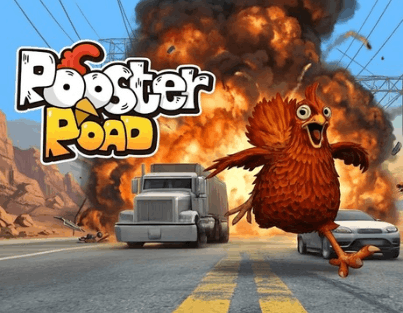
Rooster Road
Rooster Road Mods Game
Please Do Not Feed The Sprunki Brud

Endacopia

Basketball Hit
Flying Car Game Police Games

My Talking Tom Cat But With Oren
Park Fever

Goalheads Io
Flip Or Fail
Classic Sudoku Puzzle

Skillful Finger
Tomb Of The Mask Neon

Boboiboy Galaxy Run

Sprunki Footlongs Sandbox
Hamster Maze

Blobade

Flip Duel
Wheely 2

Obby Tower

Obby Parkour Ultimate

Lazy Bear








How To Play Rooster Road
"Rooster Road" features an intuitive control scheme that is simple to pick up, yet offers considerable depth for those seeking to master it. Participants can maneuver the rooster in two directions along the path—forward and backward. This two-way navigation forms the absolute foundation of the entire gameplay experience. The path itself is never stationary, as automobiles may emerge from the left, the right, or alternate angles, resulting in safe zones that are in a perpetual state of flux. Ultimately, the player is tasked with carefully analyzing the movement of traffic, pinpointing a secure opening, and then timing their progression precisely. Equally crucial is the judgment to reverse direction. Should a vehicle close in at an unexpected velocity, moving backward to a prior spot can effectively avert a potential crash.
The initial stretches of the road are considerably more lenient, affording players the necessary time to acclimate to the game's pacing. As the rooster advances further, the volume of traffic intensifies, and the movement patterns grow increasingly unpredictable. Furthermore, the game incorporates power-ups that grant short-lived benefits. These items, nevertheless, are frequently situated in hazardous zones. Consequently, the player must weigh the prospective advantages against the inherent peril. The primary aim is to lead the rooster to the greatest possible distance. Although every attempt concludes swiftly, the insights acquired from each misstep serve as the groundwork for subsequent, more successful efforts.
Rooster Road Wiki
Summary
Rooster Road presents itself as a seemingly straightforward arcade title, yet it elevates the classic “chicken crossing the road” concept into a high-intensity test of reflexes and nerve. In this game, the player guides a rooster through roads with multiple lanes, all filled with vehicles traveling at different velocities and approaching from various angles. In contrast to conventional endless runners, where forward progress is automatic, Rooster Road encourages a far more thoughtful approach: every movement must be carefully timed, every opening must be analyzed, and each choice carries its own set of consequences. The game’s charm comes from its stripped-down design—there are no convoluted mechanics, no extended tutorial segments, simply a rooster, a highway, and an endless procession of cars and trucks. However, underneath this apparent simplicity lies a surprisingly substantial level of tactical depth. Players need to find a balance between boldness and restraint, the lure of rewards versus the instinct for self-preservation, and quick maneuvers against the virtue of waiting. In the end, it is a game that newcomers can grasp within seconds, yet it still manages to deliver a formidable test of skill for experienced players. Its brief run format, combined with a steadily intensifying level of difficulty, fuels an addictive “just one more attempt” cycle that continuously pulls players back onto the asphalt.
Key Features
Rooster Road sets itself apart through a series of deliberate design choices that appeal to enthusiasts of arcade and reflex-driven games:
- Constantly shifting and unpredictable traffic: Cars, buses, and trucks approach from every direction, and safe zones are never permanent. This guarantees that every play session feels fresh and compels players to sustain their focus at all times.
- Strategic movement freedom: The option to move both ahead and backward distinguishes Rooster Road from typical endless runners. This flexibility allows players to engineer their own openings and slip away from hazardous scenarios.
- Gradual but relentless difficulty increase: The opening roads are relatively forgiving and act as a smooth introduction for beginners. Subsequent levels, however, become significantly more taxing, featuring quicker automobiles and narrower windows of safety. This carefully calibrated progression ensures that players are perpetually pushed to improve.
- High-stakes power-up design: Boost items can provide valuable assistance, but they frequently appear in extremely risky positions. Such placement establishes a constant dilemma between pursuing a short-term benefit and prioritizing long-term survival.
- Exceptional replayability: Because each attempt can conclude almost instantly, players feel a natural urge to restart and try once more. The motivation to exceed a previous distance is immensely strong, and the mechanics consistently reward both practice and close observation.
- Uncluttered and focused visuals: The game deliberately emphasizes pure gameplay rather than intricate graphics or storytelling. This minimalist approach enables players to direct all their attention toward the fundamental challenge, resulting in an authentic evaluation of hand-eye coordination and decision-making ability.
Precautions/Tips
Although Rooster Road is simple to understand, anyone hoping to reach notable distances should approach it with self-control and strategy. The following precautions and suggestions are designed to boost your chances of survival and help you steer clear of frequent errors.
- Avoid rushing ahead. The most typical mistake is moving forward without stopping. Instead, wait until a clear and safe opening appears, then advance with purpose and certainty.
- Inspect the full roadway. Do not limit your gaze to the closest vehicle; instead, take in the entire traffic pattern across all lanes. This wider awareness grants you additional time to anticipate and plan your sequence of moves.
- Make use of backward movement. Stepping in reverse is not an indication of defeat; it is a smart tactical withdrawal that can rescue the rooster from an impending accident.
- Pass on unnecessary power-ups. If a bonus item is tightly surrounded by moving vehicles, simply let it go. Remaining alive is always far more important than collecting a temporary advantage.
- Keep your nerve during chaotic moments. As traffic becomes increasingly frantic, panic will only lead to poor judgment and accidents. Pause for a moment, take a deep breath, and direct your attention only to the next viable gap.
- Extract lessons from every failure. After each collision, reflect on what contributed to the mishap. Was a vehicle’s speed misjudged? Did you move prematurely? Carry these insights into your following attempt to prevent repeating the same mistake.
- Develop muscle memory progressively. Reflexes sharpen through repeated exposure and play. The more time you invest, the more adept you become at interpreting vehicle movements and refining your sense of timing.
- Set practical, short-term goals. Rather than trying to cross the entire road in a single sweep, concentrate on progressing from one safe gap to the next. This incremental approach reduces stress and promotes far better decision-making.
Ultimately, Rooster Road rewards those who demonstrate patience and acute observation. Players who treat the traffic with respect and fight the temptation to take unnecessary gambles will discover a game that is equally demanding and profoundly satisfying.
Rooster Road Frequently Asked Questions
Q: Could you explain what Rooster Road is?
A: Rooster Road is an entertaining arcade title in which players guide a small chicken through busy thoroughfares filled with cars, trucks, and other traffic that constantly speeds past.
Q: What goal must the player accomplish in Rooster Road?
A: The player's main goal is to guide the chicken across the road to the opposite side.
Q: How is the road itself described in Rooster Road?
A: The roadway never stops moving, and vehicles may come from a variety of directions. Areas that feel safe tend to vanish rapidly.
Q: What approach is recommended for moving safely?
A: Rather than moving forward nonstop, you should scan ahead and wait for the proper opening to advance. In some cases, retreating a step is the wiser option for getting out of a perilous spot.
Q: In what way does the challenge evolve while playing?
A: As you progress, avoiding collisions grows increasingly demanding, with cars and trucks constantly generating unpredictable scenarios.
Q: Can you describe the power-ups in Rooster Road and the danger they bring?
A: Power-ups, also called rewards, grant helpful benefits and make the experience more entertaining, but collecting them can carry risk when a large number of vehicles are approaching.
Q: What is the most important factor for lasting longer in Rooster Road?
A: Patience is essential. Rather than hurrying forward, pay attention to the flow of nearby traffic, exploit safe openings, and stay prepared to move backward if needed.
Q: Why do players find the game so attractive?
A: Its charm comes from the "one more attempt" sensation. A single round can finish in an instant, which pushes players to try once more in hopes of beating their previous score.
Q: What should you do after losing a round?
A: After every failure, take note of the exact mistake you made and use that knowledge to do better on the following attempt.
Q: Does a player's ability get better over time?
A: Certainly. As your reflexes sharpen, even routes that look overwhelmingly chaotic become much more manageable.
Q: What other game does the description compare it to?
A: The text mentions Cuby Road as a comparable game.
Q: How would you characterize Cuby Road?
A: Cuby Road features straightforward yet challenging arcade action, centered on precise movement, avoiding obstacles, and fast reactions. It is simple to pick up, yet achieving high scores is quite tough.