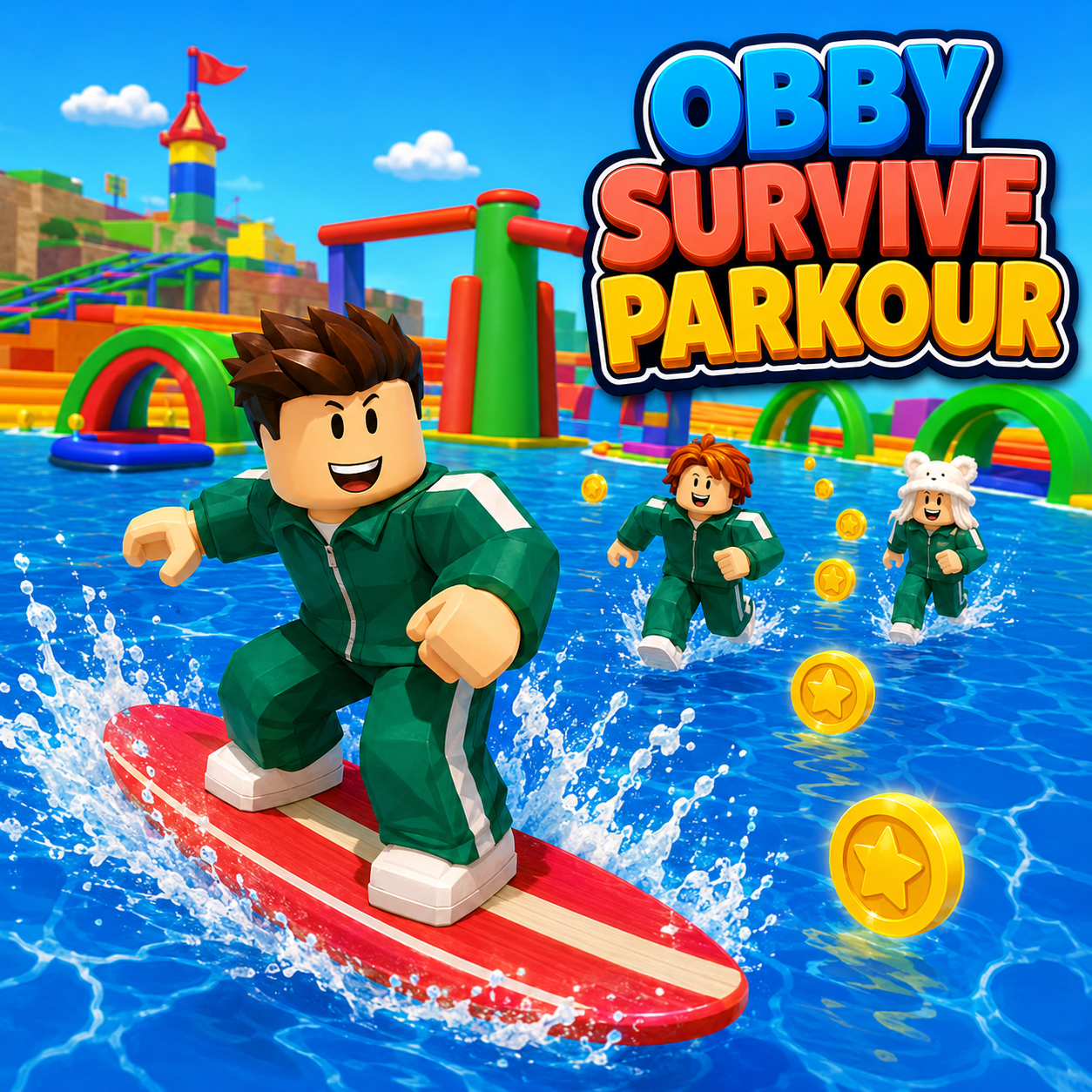
Obby Survive Parkour
Obby Survive Parkour Mods Game
Sprunki Square Shifted

Bees Empire Clicker

Paint Or Hunt
Super Bear Adventure
Brave Squad
Sprunki Hyper Shifted Phase 3 Remastered

Left Or Right Spranki Beats

1 Speed Keyboard Lucky Escape
Traffic Racing

Rider Rush
Sprunki Phase 9 Ggtp

Rooster Road
Please Do Not Feed The Sprunki Brud
Endacopia

Basketball Hit
Flying Car Game Police Games
My Talking Tom Cat But With Oren
Park Fever

Goalheads Io
Flip Or Fail






How To Play Obby Survive Parkour
In Obby Survive Parkour, the basic control scheme remains unchanged across all levels. Racer one moves with WASD, jumps using Space, and triggers a double jump by pressing Space twice. Racer two navigates with the arrow keys and uses J to jump or double-jump. In two-player mode, both participants are granted three additional powers: freeze, bomb, and acceleration. The first player can activate freeze with Q, bomb with E, and acceleration with F; the second player uses H, K, and L for the corresponding effects. These skills can either interrupt the opponent's progress or assist the user in closing the distance. The freeze orb bomb works best near a challenging obstacle, since it makes the opponent pause to recover while you move ahead. Acceleration should be kept for open areas where maintaining momentum won't lead to overcorrecting into a hazard. In solo mode, however, all abilities are stripped away, forcing the player to rely solely on movement and the ability to read hazards.
The ever-changing stage conditions demand distinct tactics:
- Lava: As the lava level climbs, you must evacuate lower sections and make your way toward elevated platforms. Reaching the finish line is still the priority, but every move forward should put you within reach of another secure location. Getting stuck with no safe place to land is a fatal mistake.
- Tsunami: A massive surge of water sweeps through the map. Prior to its arrival, find higher ground or commandeer a nearby vehicle. This level penalizes delayed reactions and favors those who plan their route in advance.
- Avalanche Storm: Enormous snowballs barrel across the track, blocking the most obvious shortcuts. Always check their movement direction before attempting to cross exposed terrain. Choosing a route simply because it appears to be the shortest can prove lethal; occasionally, holding back for a few seconds is the safer option.
- Sky Parkour: Tight platforms and floating barriers require precise launch timing and careful landing control. The double jump is essential in this stage; a correctly timed extra leap can increase your distance and fix an underpowered initial jump. Hold onto the second jump until the right moment rather than expending both jumps at once.
- Red Light, Green Light: Proceed only when the signal gives permission, and come to a halt immediately after it changes. Delaying your start costs valuable time, but failing to stop in time may eliminate you from the competition. This stage tests more than quick reflexes; it demands steady discipline while under stress.
These examples demonstrate that achieving success requires identifying the present danger, choosing an appropriate path, and determining the right moment to move forward. In two-player races, you also have to account for the opponent's abilities. Keeping track of the other racer is necessary, but losing sight of an approaching wave or the edge of a platform can end your own run first. This creates a delicate balance between racing and survival: you are never just trying to be the fastest, but also the most strategic.
Obby Survive Parkour Wiki
Summary
Obby Survive Parkour, created by gameVgames, is a 3D platforming and survival experience that drops players into obstacle courses shaped by catastrophic events. It supports solo progression and local two-player competition, with both modes sharing the same fundamental goal: endure the current stage and cross the finish line. The courses include narrow walkways, raised platforms, environmental hazards, and large-scale threats capable of eliminating anyone positioned incorrectly. What sets Obby Survive Parkour apart from typical parkour titles is that each disaster fundamentally alters the way movement should be approached. A lava stage forces upward progress as molten liquid consumes lower terrain; a tsunami stage demands locating high ground or seizing a vehicle before the wave arrives; an avalanche storm stage requires reading the trajectories of rolling snowballs before venturing across open areas; sky parkour stages test pure platforming precision; and red light, green light stages impose strict start-and-stop discipline. Some levels reward quick reflexes, while others call for patience, observation, and deliberate positioning. As a result, mastering one course does not guarantee success in the next. Players must acquire not only basic jumping skills but also the ability to identify safe routes within a moving disaster. This blend of 3D platforming, survival instincts, obstacle navigation, two-player racing, and parkour movement gives the game a distinct position among lightweight competitive platformers. Those seeking short, intense sessions will find its accessible controls and varied stage logic immediately appealing.
Key Features
- Disaster-Centric Level Design: Each course revolves around a distinct environmental threat, ranging from rising lava and tsunamis to rolling snowballs and aerial platforming. This diversity keeps gameplay fresh and prevents any single movement strategy from dominating every stage.
- Solo and Local Two-Player Modes: The game accommodates both single-player playthroughs and local head-to-head races. In two-player mode, freeze, bomb, and acceleration abilities add tactical depth without overshadowing the core survival requirements. The same objective appears in two different contexts: personal endurance and competitive disruption.
- Double Jump as a Fundamental Movement Mechanic: The ability to jump twice before landing grants players extra reach, recovery options, and route flexibility. A well-timed double jump can extend a leap onto a distant platform or compensate for a poorly timed first jump, making it vital for sky parkour stages and urgent escapes from hazards.
- Competitive Ability Arsenal: Freeze and bomb can disrupt the opponent, while acceleration allows rapid ground coverage. Their effectiveness depends entirely on timing; using them at the wrong moment can leave you exposed or squander an opportunity. This makes two-player mode more about strategic interference than simple racing.
- Accessible Controls: The keyboard layout is simple enough that players can concentrate on reading hazards rather than complex input sequences. Movement, jumping, double jump, and ability commands are grouped intuitively for each player, enabling quick responses during chaotic stages.
Precautions/Tips
- Treat every course as a dynamic problem, not a static racetrack. Observe the nature of the threat before choosing a route. If a stage centers on a tsunami, locate high ground as early as possible. If an avalanche storm is present, map the paths of the snowballs before crossing open terrain. Planning often outweighs raw speed.
- Preserve your double jump. It is tempting to press jump twice immediately, but saving the second jump provides a safety net for fixing a short landing, dodging an unexpected hazard, or bridging a gap that requires extra distance. In sky parkour stages, that extra control can mean the difference between staying on course and falling into the void.
- Match your pace to the stage's rhythm. Lava stages reward urgent upward climbing, but you should still remain aware of the next safe platform. Red light, green light stages demand immediate stops, yet starting too late wastes time, while stopping too late eliminates you. Practice learning each interval and train yourself to react without hesitation.
- Use abilities tactically in two-player mode. A well-timed freeze or bomb near a complex obstacle can create a meaningful lead. Acceleration works best on a clear route where you can maintain control; using it while navigating narrow platforms can easily backfire. Keep track of both the opponent and the environment, because losing sight of an incoming wave or platform edge can end your run first.
- Patience is a legitimate strategy. Some courses are designed to punish overcommitment. Stepping back, waiting for a snowball to pass, or pausing to observe the platform layout can save a run. However, patience must be balanced with urgency, especially when hazards are expanding. Learn to recognize when waiting is safe and when movement is mandatory. This ability to read the current threat and choose the right moment to move is what separates a successful run from a short one.
Obby Survive Parkour Frequently Asked Questions
Q: What exactly is Obby Survive Parkour?
A: Obby Survive Parkour is a title crafted by gameVgames that blends three-dimensional platforming with survival-based trials. Its stages are built around narrow walkways, raised platforms, environmental hazards, and sweeping threats that demand constant attention.
Q: Which game modes can you play in Obby Survive Parkour?
A: The game includes a solo experience as well as a local two-player mode for competitive play.
Q: What is the main goal in Obby Survive Parkour?
A: Your primary goal is to endure the active stage and make your way to the finish line before the environment eliminates you.
Q: What disaster-themed stages appear in Obby Survive Parkour?
A: The stage lineup consists of Lava, Tsunami, Avalanche Storm, Sky Parkour, and Red Light, Green Light.
Q: How is the Lava stage played?
A: In the Lava stage, rising molten rock pushes you toward higher ground. Progressing toward the finish line matters, but every step forward should keep you within reach of another safe spot.
Q: How is the Tsunami stage played?
A: A massive wave sweeps across the entire area. Your task is to reach elevated terrain or hop into an available vehicle before the water arrives.
Q: How is the Avalanche Storm stage played?
A: Huge snowballs roll through the course and break up direct paths. Before crossing open sections, you should study their movement patterns and time your advance carefully.
Q: How is the Sky Parkour stage played?
A: Sky Parkour consists of narrow ledges and suspended obstacles, putting extra emphasis on precise jump timing and stable landings.
Q: How is the Red Light, Green Light stage played?
A: You advance while the signal gives permission and halt the moment it changes. Delaying your start wastes valuable time, while braking too late may take you out of the race entirely.
Q: How does the double jump function in Obby Survive Parkour?
A: Your character is able to jump twice before touching the ground. A properly timed second jump extends your distance and can compensate for a poor first jump. Holding onto the extra jump until it is truly needed gives you more control than firing both jumps at once.
Q: What abilities are available in two-player mode?
A: In two-player mode, each racer gets access to freeze, bomb, and acceleration powers. Freeze and bomb are useful for disrupting the opponent, while acceleration lets you close gaps and move across the map faster.
Q: What are the controls for Player 1?
A: Player 1 uses WASD for movement, Space for jumping, Space twice for a double jump, Q for freezing, E for dropping a bomb, and F for acceleration.
Q: What are the controls for Player 2?
A: Player 2 uses the Arrow keys for movement, J for jumping, J twice for a double jump, H for freezing, K for dropping a bomb, and L for acceleration.
Q: What strategies are effective in Obby Survive Parkour?
A: Approach every course as a constantly shifting challenge. During wave-based stages, locate high ground early. Before entering exposed zones, study how obstacles behave. Save your double jump for risky landings. In competitive matches, use abilities only when they can influence the outcome without pulling your focus away from the stage’s primary danger.
Q: What makes each stage feel unique in Obby Survive Parkour?
A: The controls stay the same throughout, but the conditions around you change frequently. Every level introduces its own survival rule, and the shifting hazards make route planning, timing, and situational awareness equally vital to success.