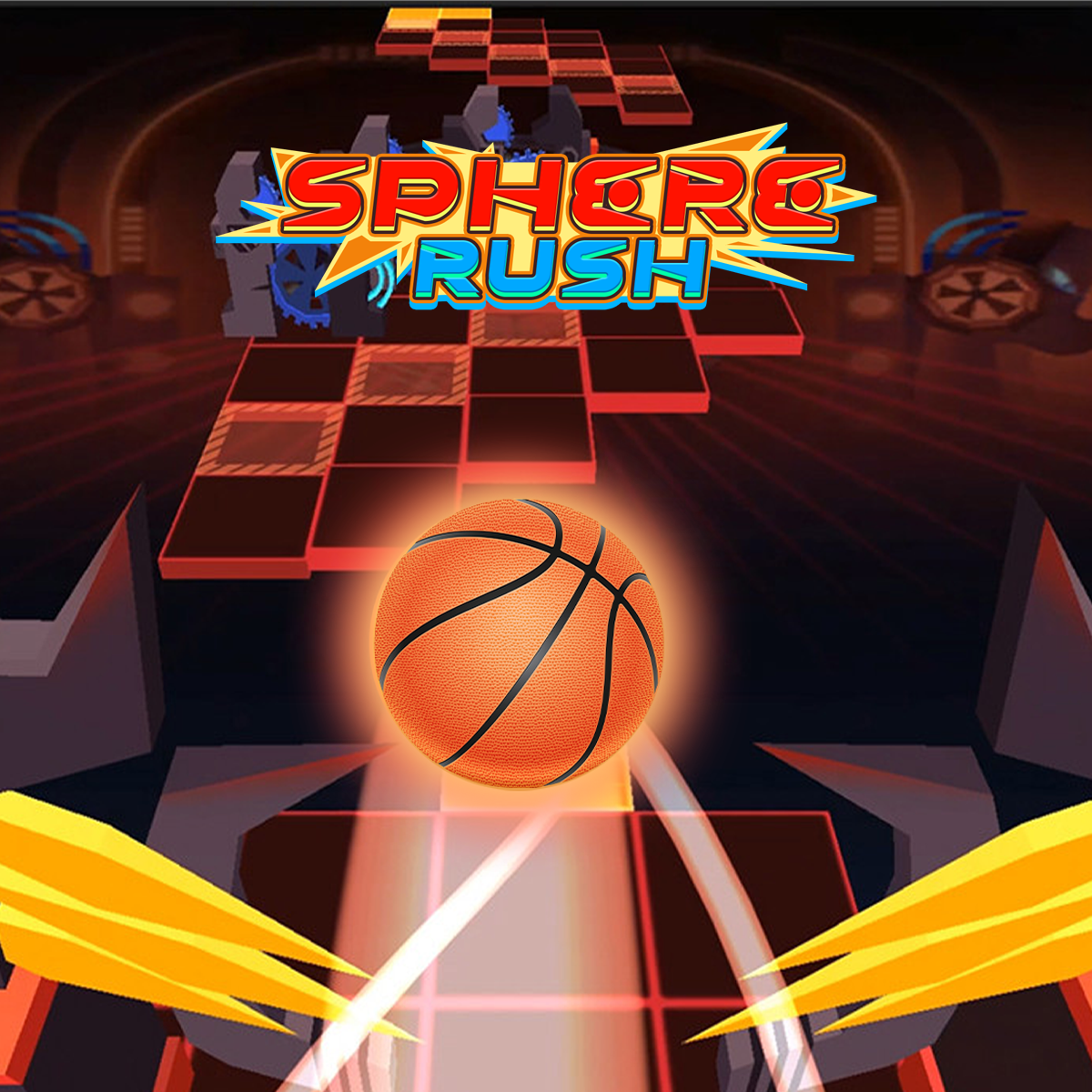
Sphere Rush
Sphere Rush Mods Game
Squidgameio
Tag Run
Sprunki Mixcinki
Sprunkway V2
Obbik Military Tycoon
Escape The Alien Prison

We Become What We Behold
Blocky Xtreme
Shadowman Runner
Vex 9
Xytrian Runner

Fireboy And Watergirl 3 Ice Temple

Idle Planet Gym Tycoon
School Escape Obbie Run
Slope Run

Prison Pump
Ski Safari
Crunch Locked
Sprunki Phase 5 The Blackened Killer Remake

Candy Jump




How To Play Sphere Rush
The core gameplay mechanics of Sphere Rush revolve around automatic forward movement combined with user-directed sideways navigation. The sphere moves ahead without interruption, assigning the player the sole duty of moving it either to the left or to the right in order to evade ha.
Sphere Rush Wiki
Summary
Sphere Rush is a precision-driven arcade platformer that places players in control of a rolling ball navigating a series of increasingly treacherous obstacle courses. Published on July 13, 2026, the game belongs to the lineage of fast-paced, reflex-based titles that demand sharp timing and unwavering concentration. Its core premise is deceptively simple: guide the ball from the start of each level to the finish line without colliding with traps or falling off the platform. What elevates Sphere Rush beyond a casual time-waster is its careful escalation of difficulty, clean visual design, and responsive controls that reward incremental mastery. Each level presents a unique combination of moving barriers, sudden gaps, and narrow pathways, forcing players to read the environment ahead and react with measured, deliberate movements. The game abandons complex mechanics in favor of a pure test of hand-eye coordination, making it accessible to newcomers while still offering a satisfying challenge for veteran platformer enthusiasts. With multiple environments, a gradual difficulty curve, and short, replayable stages, Sphere Rush captures the essence of the genre: one mistake can end a run, but each failure provides the knowledge needed to overcome the next attempt.
zards. This single-axis control scheme strips away unnecessary complexity, placing the entire challenge on the player’s ability to anticipate obstacles and execute precise lane changes.
Controls On a computer, the player holds and drags the mouse left or right to steer the ball. The same motion is replicated on mobile devices by touching and sliding a finger across the screen. The developers emphasize the importance of small, steady movements, especially on narrow platforms where overcorrection can lead to an immediate fall. The sensitivity is tuned to feel responsive without being twitchy, allowing for both quick dodges and fine adjustments.
Level Progression The game opens with a tutorial-like first stage featuring wider platforms and fewer traps, giving players a chance to acclimate to the ball’s physics and steering response. As the player advances, courses introduce tighter routes, faster obstacle patterns, and hazards placed in close succession. Gaps in the track become more frequent, moving barriers appear with less warning, and the visual clutter of each environment changes—yet the core logic remains the same: read the path, steer accordingly, and survive.
All levels are available from the start, meaning players can choose to follow the natural difficulty curve or jump directly to a later stage for a sterner test. However, because each level has a unique layout, jumping ahead without practice often results in repeated failures. The game encourages a sequential approach, as familiarizing oneself with the obstacle patterns of earlier stages builds the muscle memory and spatial awareness needed for later, denser courses.
Failure and Learning A single collision with a trap or a misstep off the edge ends the current run immediately, forcing a restart from the beginning of that level. There are no checkpoints or continues. This design choice keeps each attempt short—typically between thirty seconds and two minutes—and reinforces a trial-and-error learning loop. Each failure reveals a new section of the course layout, and with repeated attempts, the player internalizes the timing and positioning required to navigate each hazard. The game does not punish the player with penalties or loss of progress; rather, it treats each run as a fresh opportunity to improve.
Key Features
-
Fast-Paced Rolling-Ball Gameplay – The core mechanic of guiding an automatically rolling ball through obstacle courses is immediately intuitive and highly engaging. The constant forward motion creates a sense of urgency, while the simplicity of the controls allows players to focus entirely on reaction and precision.
-
Simple and Responsive Steering Controls – The mouse-drag or touch-slide input is both natural and precise. The game’s control scheme is designed to minimize input lag, ensuring that every movement of the player’s hand is translated directly into the ball’s lateral shift. This responsiveness is critical for navigating the tight corridors and rapid hazard sequences found in later levels.
-
Multiple Levels with Distinct Environments – Each course features a different visual theme, ranging from neon-lit tunnels to abstract geometric landscapes. While the underlying gameplay remains consistent, the changing aesthetics help maintain visual interest and prevent the experience from feeling repetitive. The platforms themselves vary in color, texture, and lighting, but the clean graphics ensure that obstacles remain clearly visible against the background.
-
Increasingly Complex Obstacle Patterns – The developers have carefully curated a difficulty curve that introduces new types of hazards gradually. Early levels may feature static blocks and predictable gaps, while later stages incorporate moving barriers, spinning blades, collapsing platforms, and sequences that require split-second lane changes. The placement of traps is designed to test not only reflexes but also the player’s ability to plan two or three moves ahead.
-
Clean Graphics That Keep Hazards Visible – Visual clarity is a hallmark of Sphere Rush. The ball is rendered in a bright, contrasting color, and all obstacles are clearly outlined against the platform. There is no unnecessary particle effects or screen shake that could obscure the player’s view. This design philosophy ensures that the player’s failures are always the result of their own timing, not of visual confusion.
-
Short and Replayable Challenges – Each level can be completed in under two minutes, making the game ideal for quick sessions. The lack of checkpoints means that a single perfect run is deeply satisfying, and the randomized-like feel of obstacle patterns (though hand-crafted) encourages repeated attempts. The “just one more try” loop is strong, as players feel they are always on the verge of mastering a tricky section.
Precautions/Tips
-
Master Small, Controlled Movements – Oversteering is the most common mistake among new players. The ball’s momentum carries it quickly, and a large swipe can send it careening off the edge. Practice using minimal mouse or finger movement to make fine adjustments. On narrow platforms, it is often better to nudge the ball slightly rather than to jerk it abruptly.
-
Look Ahead, Not at the Ball – Your eyes should be scanning the path several seconds ahead of the ball’s current position. Fixating on the ball itself leads to delayed reactions. By anticipating the next obstacle, you can plan your steering input in advance, which is especially important for sequences of closely spaced traps.
-
Accept Failure as Part of the Learning Process – Sphere Rush is designed to be difficult. Do not become frustrated by repeated deaths; instead, treat each attempt as a reconnaissance run. Note the location of specific hazards and the timing of moving obstacles. Mental mapping of the course is the key to consistent success.
-
Practice on Earlier Levels to Build Reflexes – Even if you are tempted to jump to a later stage, spend time on the first few courses until you can complete them without mistakes. These early levels teach the fundamental physics of the ball—how it responds to input, how it drifts on turns, and how momentum affects your ability to stop or change direction. This foundation is invaluable for harder stages.
-
Maintain a Consistent Rhythm – While the ball moves forward automatically, try to keep your steering inputs smooth and rhythmic. Jerky, panicked movements often lead to overcorrection and falls. If you find yourself in a tight spot, take a half-second to breathe and make a single decisive move rather than a flurry of adjustments.
-
Be Aware of Environmental Hazards Beyond the Obvious – Some traps are designed to trick you. A gap may appear after a blind corner, or a moving barrier may speed up unexpectedly. The game occasionally uses visual distractions—such as alternating colors or flashing lights—to draw your attention away from the actual threat. Stay focused on the direct path ahead.
-
Use the Full Width of the Platform – Many players instinctively hug the center of the track, but this leaves little room for error when obstacles appear on both sides. Instead, learn to use the full width of the platform to your advantage. Position yourself near the edge opposite an approaching hazard, giving yourself more time to react if the trap changes direction.
-
Take Breaks to Avoid Fatigue – The constant demand for high concentration can be mentally exhausting. If you find yourself making repeated mistakes on a section you previously mastered, step away for a few minutes. A refreshed mind is far more effective than a tired one. Sphere Rush rewards patience, not brute persistence.
Sphere Rush Frequently Asked Questions
Q: What is Sphere Rush? A: Sphere Rush is a high-speed arcade platformer that was released on July 13, 2026. The game tasks you with navigating a rolling sphere through courses filled with obstacles, relying on simple directional controls and accurate timing.
Q: What is the goal of Sphere Rush? A: Your objective is to arrive at the finish line of every stage without colliding with a trap or falling off the edge of the platform.
Q: How do you control the ball in Sphere Rush? A: The sphere automatically rolls forward, and you are responsible for moving it to the left or right. On a desktop computer, click and drag the mouse left or right to steer. On a mobile device, touch and swipe your finger across the display.
Q: What happens if you make a mistake in Sphere Rush? A: A single error will end your attempt, yet each try allows you to memorize the stage design and get ready for challenging segments.
Q: Are the controls difficult to learn? A: No, the controls are straightforward to grasp. However, tight walkways, unexpected drops, and shifting barriers turn every level into a demanding test of focus and hand-eye coordination.
Q: What is the best way to steer on narrow platforms? A: Employ gentle and consistent movements to achieve greater precision when crossing thin surfaces.
Q: How does the difficulty progress in Sphere Rush? A: Earlier levels provide broader paths and fewer hazards, allowing you to get used to the movement system. Later stages introduce narrower routes, quicker obstacle patterns, and traps positioned very close together.
Q: Are all levels available from the beginning? A: Yes, every stage is unlocked from the start, enabling you to either follow the natural increase in difficulty or jump straight into a more demanding course.
Q: What are the game highlights of Sphere Rush? A: Key features include rapid rolling-ball action, simple and responsive steering mechanics, multiple levels featuring diverse environments, increasingly intricate obstacle designs, clean visuals that keep dangers easy to see, and short, replayable challenges.
Q: When was Sphere Rush published? A: Sphere Rush was launched on July 13, 2026.
Q: What genre is Sphere Rush? A: It belongs to the casual platformer genre, incorporating elements of obstacle avoidance, ball control, and arcade-style gameplay.
Q: How do you report a bug in Sphere Rush? A: You can submit a bug report by choosing the "Report a bug" option and detailing the issue you encountered—for example, the game failing to load, not functioning, losing progress, containing inappropriate material, or other problems.
Q: Can you share Sphere Rush with friends? A: Absolutely, you can share the game with others by copying the provided link.
Q: What should you watch for while playing? A: Keep an eye on the route ahead and reposition yourself before encountering barriers, openings, or other dangers.
Q: Is Sphere Rush a single-player or multiplayer game? A: According to the available information, Sphere Rush appears to be a single-player arcade platformer that emphasizes personal skill and reaction time.