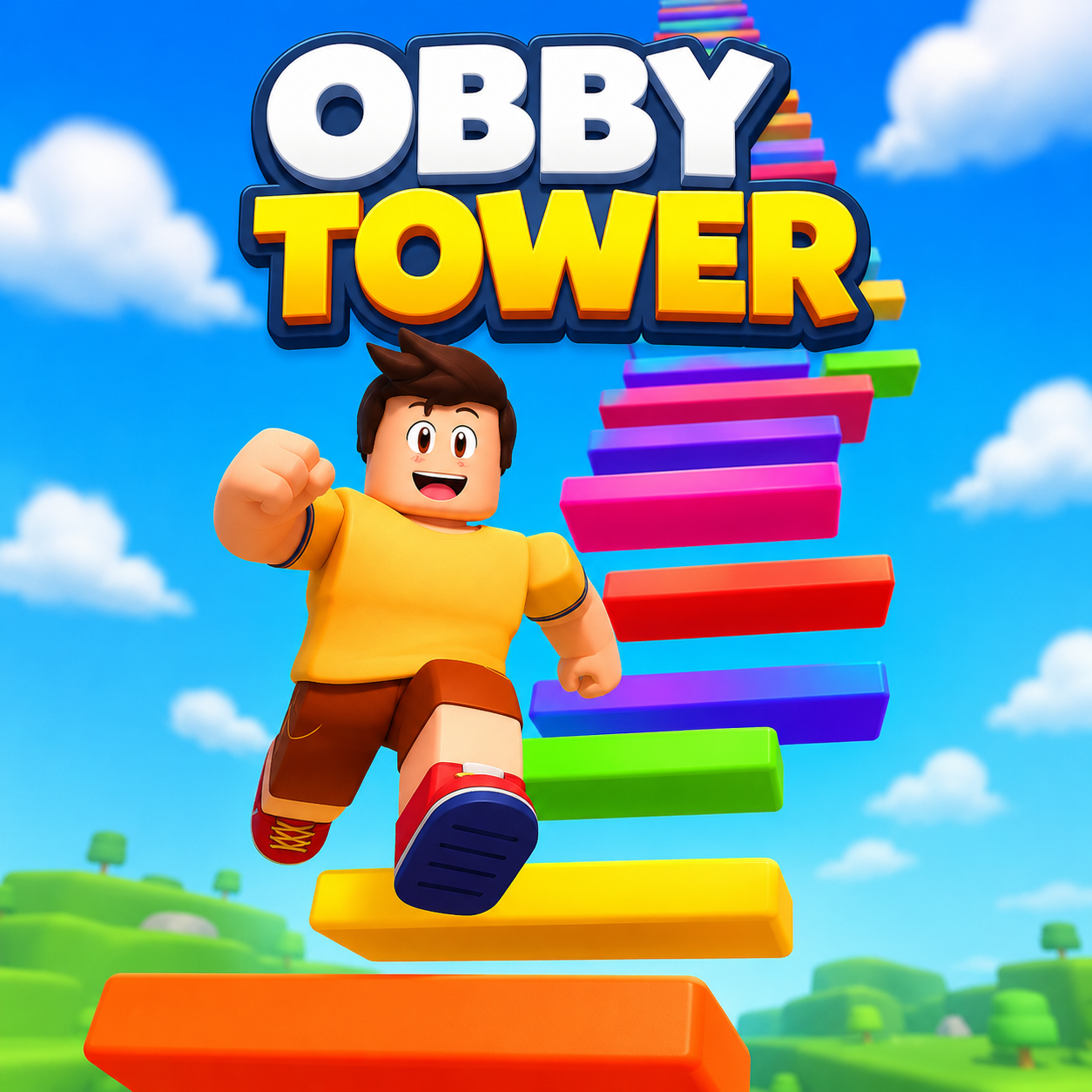
Obby Tower
Obby Tower Mods Game








How To Play Obby Tower
The fundamental gameplay mechanics of Obby Tower revolve around traversing a suspended world through carefully timed leaps, controlled acceleration, and deliberate problem-solving. Prior to initiating a session, the player is required to choose a course setting, with the two starting alternatives being Playground and Rainbow. Each setting offers a distinct arrangement of barriers, hazards, and aesthetic motifs, which collectively shape the overall experience. Subsequently, the player selects a difficulty tier—Easy, Medium, or Hard—which directly determines the intricacy of the platforming segments and the configuration of obstacles.
The core experience comprises two interconnected yet distinct activities. Navigation is executed via conventional first-person controls, demanding that players convert their spatial awareness into precise inputs. The ability to accurately gauge jump distances and angles is essential, given that platforms differ in dimensions and some may shift position or contain obstructions. A critical element of achieving mastery lies in the judicious application of the sprint mechanic. This feature grants the additional velocity necessary to clear wide gaps, yet it simultaneously heightens the likelihood of overshooting narrower platforms, rendering its measured use an essential competency to cultivate. Additionally, the game compels players to pause and resolve arithmetic problems that manifest as barriers or screen-based prompts. This feature introduces a shift in cognitive focus, necessitating calmness to perform numerical calculations while positioned in a precarious three-dimensional setting.
Advancement is safeguarded by checkpoint markers, represented by a rotating "C" located along the course. Making contact with these indicators records the player's progress, guaranteeing that any misstep results in a respawn at that location rather than at the starting line. Beyond the straightforward parkour elements, participants must also choose among several multi-option platforms, each presenting a different path forward. This hybrid methodology—merging physical agility with rapid mental computation—constitutes the game's distinctive challenge profile. The configuration and control menus grant users the flexibility to alter their viewpoint, an adjustment that can prove vital for executing particular jumps or obtaining clearer sightlines for puzzle elements.
Obby Tower Wiki
Summary
Obby Tower offers a unique blend of exacting platform mechanics and intellectual tasks, establishing itself as a trial of both manual skill and mental sharpness. The experience places participants inside a towering 3D obstacle route suspended in the sky, where the path consists of a chain of hovering stages, each offering its own set of barriers. In contrast to classic parkour games that depend purely on timing and reflexes, Obby Tower embeds elementary arithmetic problems directly into the level design, compelling players to solve calculations in order to open gates or pick the correct landing spots. This establishes a cadence that alternates between pure navigational segments and moments requiring thoughtful evaluation, yielding a distinct playstyle within its category.
The design remains approachable for beginners and also offers enough progression to test veterans. By splitting the long course into checkmarked stretches, the creators have reduced the annoyance normally found in the parkour genre, where an individual fall can trigger substantial setback. Players can select their desired level of commitment through several difficulty modes, enabling a customized experience. Obby Tower goes beyond just timing; it provides a complete workout in spatial reasoning, body awareness, and keeping calm under stress, making it an attractive option for those who enjoy refining skills and conquering layered challenges.
Key Features
- Dual-Path Progression: The title provides two separate virtual tracks for play: Playground and Rainbow. Every track boasts its own environment with a unique aesthetic and various movement tests, effectively offering twice the gameplay under a single package.
- Tiered Difficulty System: A modifiable three-step difficulty setting (Easy, Medium, Hard) lets players calibrate the challenge, making the experience as accommodating or as demanding as desired. This supports beginners in mastering foundational mechanics and gives experienced players a sharper obstacle-driven edge.
- Integrated Educational Mechanics: Obby Tower prominently adopts problem-solving through arithmetic puzzles. These appear in three key ways: passing through gates, being launched toward numbered platforms, or engaging with multiple-choice interface panels.
- Fluid Character Control: Accurate manipulation forms the core of the experience. The input layout includes all essential commands for moving, leaping, sprinting, and adjusting the view. A view toggle enables both static and fluid perspectives—first-person and third-person—to suit individual preferences.
- Progressive Save System: Checkpoints indicated by a rotating "C" permit players to secure their progress at regular intervals throughout the stage. Coupled with the "Top Bar" visual indicator that monitors completion, this fosters a feeling of stability and confidence, lessening the cost of any misstep.
- Environmental Interactivity: The stages are far from inert. They contain hatch doors, spinning barriers, tight lanes, and other active hazards. The reactive landscapes respond to timing and pattern-based dangers, guaranteeing great repeatability.
Precautions/Tips
Achieving success in Obby Tower requires smart planning in addition to fast reactions. One crucial element is handling the camera; aiming a jump is nearly impossible if you cannot see the destination. It is wise to rotate the view first so that the intended platform becomes visible. Always ensure you touch the checkpoint before undertaking risky moves, since direct contact with the marker is necessary—simply standing next to it will not trigger it. Falling after you pass a checkpoint can cost you progress, so always look at the marker to verify that it "spins" and shifts your spawn point.
Save your sprint for the right moments. Continuous sprinting across a floating track makes it much harder to perform last-second adjustments. Use the extra speed only for long-distance leaps; using it in ordinary situations can send you over the edge of a small platform. Your camera angle is a direct predictor of jump precision. In addition, take a moment to stop and work out the answer to a puzzle. The arithmetic itself is not the real test, but performing the calculation without losing your positional awareness can be tricky. There is often a safe area before making a decision where you can pause and think.
If this is your first experience, or you consider yourself a beginner, start with the Easy difficulty. This option lets you develop a feel for jump distances and control sensitivity without being overwhelmed by distractions. Keep in mind that hard modes are not simply variations with larger numbers—they can modify the track structure and the number of hazards, demanding much more precision and perfect timing. Also, if you do fall, do not panic. The checkpoints are placed strategically to reduce the consequences. Spend a second to check your location using the progress bar and analyze the next section; mentally rehearsing a difficult jump or puzzle can greatly boost your consistency. Finally, do not forget to use the pause function (Enter key) to rest or inspect the situation without any time pressure.
Obby Tower Frequently Asked Questions
Q: What is Obby Tower?
A: Obby Tower is a 3D platforming experience that merges precision-based parkour with straightforward arithmetic challenges. The goal is to traverse an extended series of suspended platforms, navigate through various impediments, and ultimately arrive at the endpoint.
Q: What sets Obby Tower apart from other parkour titles?
A: The gameplay isn't solely reliant on leaping. Certain segments demand careful regulation of velocity and orientation, while others require solving a numerical problem before advancing. Checkpoints partition the route into smaller, digestible segments, meaning a single misstep doesn't necessarily wipe out your entire progress.
Q: Which obstacle courses are offered in Obby Tower?
A: At the outset, you have the option to pick between two distinct courses: Playground and Rainbow. Each course features its own unique layout of vivid platforms, voids, hazards, and dynamic components.
Q: What difficulty settings are available to me?
A: You can opt for Easy, Medium, or Hard difficulty. Easy serves as a sensible entry point for mastering the controls and gauging jump distances. Once your movement becomes more reliable, Medium and Hard present chances to challenge your timing and exactness.
Q: What kinds of obstacles can I expect in the parkour segments?
A: Expect to encounter trap doors, spinning bars, slender walkways, and moving hazards. Certain leaps can be executed from a stationary stance, whereas larger gaps might necessitate a brief burst of speed.
Q: How crucial is camera positioning in Obby Tower?
A: Camera positioning holds equal weight to movement. Prior to jumping, rotate the camera toward your target and verify the character is oriented correctly. An improper angle can cause you to overshoot the platform even if the jump distance is accurate.
Q: Should I sprint continuously during gameplay?
A: No. Sprint only when additional momentum is required. Constant running makes halting on compact platforms more difficult and heightens the chance of slipping off an edge.
Q: What formats do the math puzzles adopt?
A: Math puzzles appear in three primary styles:
- Pass through the gate that displays the correct solution.
- Leap onto the platform bearing the correct number.
- Step onto a translucent platform and select an answer from a multiple-choice panel.
Q: How should I tackle the math puzzles?
A: The arithmetic is simple, but it disrupts the flow of the parkour. Take a moment to pause, read the full equation, and compute the answer before choosing a gate or platform.
Q: How do checkpoints function in Obby Tower?
A: Checkpoints are indicated by a rotating "C." Touch the marker to activate it and preserve your current location. If you tumble later, you can restart from the most recent checkpoint rather than going back to the start.
Q: Is there any special action needed to activate a checkpoint?
A: Yes. You must make direct contact with every checkpoint you encounter. Merely approaching the marker may not trigger it.
Q: How can I monitor my advancement through the course?
A: A progress indicator at the top of the screen displays the percentage of the course completed. Use it to gauge the remaining distance and brace for upcoming sections.
Q: What are the controls for Obby Tower?
A: The control scheme is as follows:
- WASD: Move
- Space: Jump
- Shift: Sprint
- Mouse or Arrow Keys: Look around
- Enter: Pause the game
- V: Toggle between first-person and third-person perspectives
Q: Can I toggle between first-person and third-person views?
A: Absolutely. Press the V key to alternate between first-person and third-person perspectives.
Q: What are some games similar to Obby Tower?
A: Comparable games include:
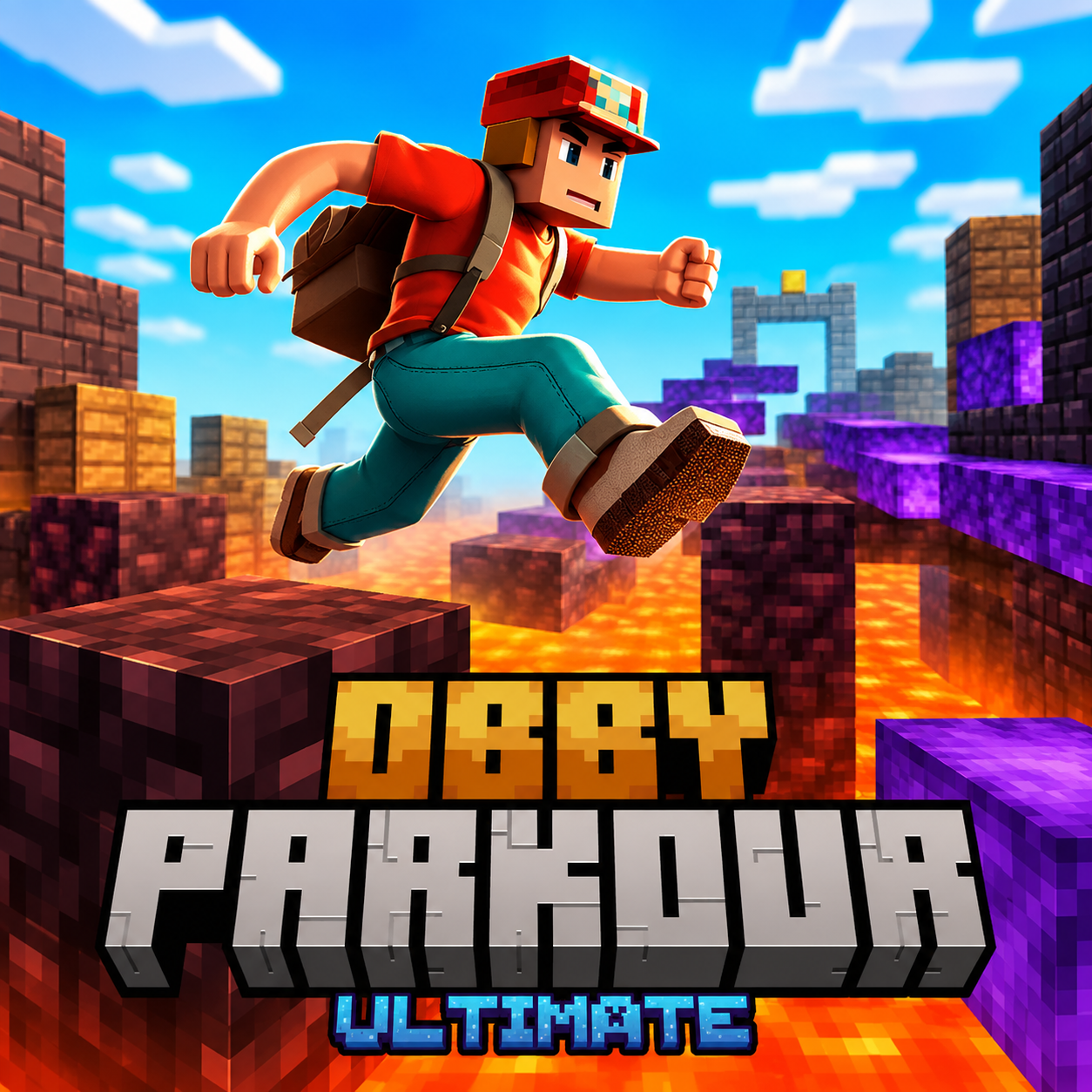
- Obby Parkour Ultimate: Navigate 35 vibrant parkour levels, dodge traps, gather coins, and unlock additional characters.
- Ragdoll Parkour Simulator: Ascend a suspended 3D path filled with thin beams, unstable platforms, vertical structures, and wide chasms.
- Only Up: Attempt a single continuous climb across pipes, trains, beams, and floating objects, where a fall can wipe out substantial progress.
Q: Which categories does Obby Tower fall under?
A: Obby Tower is classified as an Adventure, jumping, 3D, parkour, and skill-based game.
Q: What occurs if I fall after passing a checkpoint?
A: If you fall after activating a checkpoint, you can restart from the most recent checkpoint instead of going back to the course's start.