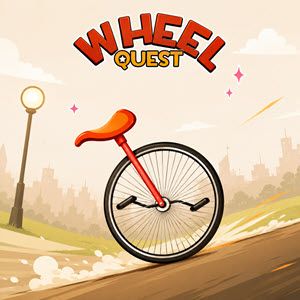
Wheel Quest
Wheel Quest Mods Game

Snail Bob 8
Airborne Bmx

Hexbound

Muscle Up Master
Mr Macagi Adventures

Poople

Brainrot Hole

Color Tunnel 2

Battalion Commander 2

Flowball

Sprunki Cute Time Ultimate

Sprunki Summer Time

Sprunki Fire Warm

Sprunkilarity3

Sprunki Jevin Treatment

Hill Sprint

Cat Life Simulator

Fireboy And Watergirl 6 Fairy Tales
Baldis Basics Classic Remastered

Mineland









How To Play Wheel Quest
The core experience of Wheel Quest revolves around a single, highly challenging mechanic: preserving equilibrium on a moving one-wheeled cycle. The player's character continually tilts in response to the wheel's movement, compelling players to execute subtle, exact adjustments in order to keep the avatar from falling. The essential strategy for achievement involves evaluating the ground ahead and reacting with smooth, well-judged commands. Over
Wheel Quest Wiki
Summary
Wheel Quest is a physics-driven unicycle game that presents riders with a seemingly straightforward goal: maintain balance and travel the greatest distance possible. The entire experience hinges on the subtle art of equilibrium, where each movement, incline, uneven surface, and leap creates a fresh chance for the rider to lose control. The game’s primary draw is its unpredictable physics engine, which encourages precise, deliberate handling and penalizes excessive adjustments or delayed responses. As riders advance, they face progressively challenging landscapes and gain access to additional unicycles, offering a continuous motivation to surpass their own record distance. Despite its simple controls and uncomplicated concept, Wheel Quest delivers a surprisingly complex challenge that evaluates both quick reflexes and thoughtful endurance. It is a game crafted for those who relish the tension between ease and difficulty, where achievement is gauged not by stages completed but by meters endured.
Overly vigorous corrections can cause a wobble that rapidly escalates into a fall, while hesitant reactions leave the rider vulnerable to gravitational forces.
Riders start on level ground, enabling them to establish a rhythm and become familiar with the fundamental control mechanics. As the path continues, the roadway introduces dips that disrupt the wheel’s steadiness, inclines that change speed and tilt, and leaps that require a stable touchdown. Each of these obstacles requires a distinct strategy: foreseeing a dip by modifying the lean before contact, shifting weight appropriately on an incline, and bracing for the landing to absorb the impact.
The controls are intentionally minimal, allowing riders to concentrate entirely on maintaining balance. On a computer, the left and right arrow keys are used to tilt or shift the rider. On handheld devices, tapping the left or right side of the screen achieves the same action. The straightforwardness of the input method masks the depth of the gameplay, as every tap must be deliberate and meaningful.
The game encourages riders to begin slowly and carefully observe the rider’s tilt angle. Short, quick taps are more effective than holding a direction for a prolonged period, as they permit finer control and faster adjustments. It is also essential to monitor the road ahead—preparing for upcoming obstacles early is much simpler than attempting to salvage balance at the last moment. Rough segments should be approached with caution, and riders should adjust their position before reaching inclines or leaps. The ultimate objective is to gradually enhance one’s distance, treating each additional meter as a personal triumph.
Key Features
- Physics-Based Balance System: The central mechanic relies on a realistic physics engine that replicates the rider’s leaning and the wheel’s momentum. Every input produces a proportional effect, making the experience feel both natural and unforgiving.
- Dynamic Terrain Challenges: The roadway is not uniform. Dips, inclines, and leaps continuously disrupt the rider’s rhythm, demanding adaptive strategies and rapid thinking. The terrain becomes more challenging as the rider progresses, ensuring that the difficulty escalates naturally.
- Unlockable Unicycles: As riders travel farther and achieve better distances, new unicycles become accessible. These cosmetic or functional variations enhance replay value and offer riders a tangible reward for their perseverance.
- Minimalist Controls with High Skill Ceiling: The control scheme is extremely straightforward—only two directions—yet mastering it requires fine motor control and split-second decision-making. This contrast between simplicity and difficulty is a defining characteristic of the game’s design.
- Endless Runner Structure: The game has no fixed levels or endpoints. The sole objective is to keep riding and surpass your previous best distance. This format encourages repeated attempts and self-improvement rather than linear progression.
- Cross-Platform Play: The game is fully playable on both computers (with arrow keys) and portable devices (with touch controls), making it accessible to a broad audience without compromising the core experience.
Precautions/Tips
- Avoid Overcorrection: One of the most frequent errors is reacting too strongly when the rider begins to tip. A large, sustained input can worsen the wobble rather than fix it. Use short, gentle taps to guide the rider back to a stable position.
- Anticipate, Don’t React: The most successful riders keep their eyes on the road ahead. By identifying inclines, dips, and leaps several seconds in advance, you can adjust your balance before the obstacle affects the wheel. Last-second corrections are rarely effective.
- Maintain a Steady Rhythm: On flat stretches, try to find a comfortable, consistent tapping pattern. This helps you build a baseline of stability that can absorb minor disturbances. Changing your rhythm abruptly can lead to loss of control.
- Land Jumps with Care: When approaching a leap, prepare for the landing by centering the rider’s tilt. The moment of impact is critical—if you are leaning too far in any direction, the landing will almost certainly result in a fall. Aim to touch down with the wheel as level as possible.
- Incremental Improvement: Do not expect to double your distance in a single attempt. Focus on improving by a few meters each run. This approach reduces frustration and builds a steady sense of progress. Even a small gain is a victory.
- Take Breaks: The game’s physics can be mentally draining. If you find yourself making repeated mistakes, step away for a few minutes. Returning with a fresh mindset often leads to better performance.
- Experiment with Unicycles: Different unicycles may have subtle differences in physics or handling. Try them out to see if any suit your playstyle better. Unlocking and testing new options can also break the monotony and provide renewed motivation.
- Watch Your Posture (If Playing on Mobile): Holding the device in a stable position can help you control the screen taps more precisely. Unsteady hands can translate into unsteady in-game balance.
Wheel Quest Frequently Asked Questions
Q: What exactly is Wheel Quest? A: Wheel Quest is a physics-driven unicycle simulation in which players maintain equilibrium on a single wheel while attempting to cover the greatest distance possible without tipping over. The difficulty arises from erratic landscapes including holes, inclines, and leaps.
Q: What is the primary goal within Wheel Quest? A: Your task involves maintaining careful balance, covering as much ground as you can, and surpassing your previous record.
Q: How does the physical simulation function in Wheel Quest? A: The rider continuously tilts along with the wheel's motion, requiring subtle adjustments to maintain stability. Excessively forceful inputs may induce instability, while delayed responses result in a crash.
Q: What kinds of surfaces are present in Wheel Quest? A: Players can expect smooth stretches for establishing a cadence, uneven ground, holes that disrupt equilibrium, inclined surfaces that alter momentum, and jumps requiring stable touchdowns.
Q: Does Wheel Quest offer incentives for achieving greater distances? A: Indeed, progressing further unlocks more challenging paths and extra unicycles, providing additional motivation to pursue a higher score.
Q: What is the fundamental approach to playing Wheel Quest? A: Begin at a low speed and closely observe the rider's tilt. Employ subtle inputs rather than maintaining continuous directional pressure. As soon as the figure starts to lean, execute a prompt adjustment before the instability escalates into a complete fall.
Q: What is the recommended method for handling irregular terrain in Wheel Quest? A: Maintain focus on the upcoming path and anticipate inclines or depressions well ahead of time. Proactive preparation is far simpler than attempting to recover control at the final moment.
Q: What are the keyboard controls for Wheel Quest on PC? A: Press the Left Arrow key to tilt or shift leftward, and the Right Arrow key to tilt or shift rightward.
Q: How does one control Wheel Quest on a mobile device? A: Tap the left portion of the display to lean or travel left, and tap the right portion to lean or travel right.
Q: What is an essential suggestion for improved handling in Wheel Quest? A: Utilize brief taps rather than prolonged holds to retain superior command and rectify your equilibrium promptly.
Q: What is the best way to navigate bumpy areas in Wheel Quest? A: Proceed through uneven segments cautiously and reposition yourself prior to encountering inclines or leaps.
Q: What attitude is advisable when aiming to extend your distance in Wheel Quest? A: Concentrate on gradually surpassing your prior record. Gaining just a few additional meters constitutes a triumph when your sole companion is an unsteady wheel.
Q: Why does Wheel Quest remain difficult in spite of its straightforward controls? A: The game maintains minimal input complexity while presenting a surprisingly substantial challenge. The straightforward yet erratic physical simulation renders maintaining an upright position arduous.
Q: What action should be taken when the rider begins to tip over in Wheel Quest? A: Execute a rapid adjustment before the minor oscillation develops into a complete overturn.
Q: Which other titles are comparable to Wheel Quest? A: Additional games worth exploring are Wacky Steps and Slope Xtreme.